Fearless and Inventive in Her Reckonings | Carl Little
A review of Rosanna Warren’s Hindsight
Over the course of (now) ten collections of poetry spanning 35 years, Rosanna Warren has established herself as one of our preeminent limners of modern life through carefully crafted lines. Marked by activated language, Warren’s poems can startle and, to quote Melville’s Ahab, “strike through the mask.”
The poet often edges into the personal. In “Burning the Bed,” she describes a makeshift backyard bonfire, the intimacy of “so much // love going up in smoke.” She is especially inventive in this turn of phrase: “privacies curled to ash-wisp.” We see and feel the fire.
The self-portrait “Snow” opens with a nurse explaining, “Your heart is photogenic, but it’s shy.” That doctor’s office visit and an old passport inspire a recognition of age, of “the crepe paper crinkle above my upper lip.”
A similar acknowledgment marks “’Concerning Ceremonies,’” one of the longer poems in the collection. Starting with memories of rebelling against The Book of Common Prayers, Warren takes us through a summer in France as a youngster, college days, a critique of Rubens, and a return to the church where she stands “heretically at an altar” to receive on her tongue “the sliver of a broken god.”
Warren often takes her cue from the natural world. A rat snake seeks entry to a house in “Number Theory,” a mother bear bats “hard green apples from the boughs” in “Soseki’s Shrine,” crickets stitch “the afternoon / together” in “Boletus,” a turkey vulture turns “death into speed” in “‘Dead Flowers.’”
“The Mud Hole” offers a memory of a “small dark pond.” This “Earth’s eye, omphalos,” occupied by leaf-sprite, frogs, water snakes and turtles that “blink / and bask,” provides a retreat, the poet writes, “where grown-ups would never find me.”
In “Gall,” Warren might be channeling biologist Bernd Heinrich in her description of parasitic symbiosis:
Still more ingenious,
the wasp that drills the oak leaf to lay her eggs,
injecting poisons that swell
the leaf into a gall, a globed papyrus
palazzo in which the commandeered tree
generates a cafeteria so the larvae can feed
until with sprouted wings and feet, lo, they chew
their way out and take flight.
At times, Warren pushes the metaphorical envelope as in this line from “In a Strange Land,” an account of visiting grizzly country: “Aspens quiver with DTs, alders swish in a corps de ballet.” The poet is fearless and inventive in her reckonings of how imagery can leap. How about these lines from “Inscription”:
Hardly has the snow
melted than the catalpa’s white torches
extinguish and summer starts sliding
into its oubliette.
Some of these poems came out of Covid, including “’They set about wasting the land,’” whose
title is drawn from Thucydides’ description of the plague in The Peloponnesian War. As Warren explained in a Poetry Daily posting, the Athenian historian’s account of the plaque “lay like a tracing” over her sense of “what was happening to us.” The ending is brutal: “When the plague / broke us We broke each other.”
Over the years, Warren has written some notable ekphrastic poetry, including riffs on works by Pierre-Auguste Renoir, Marc Chagall, Max Beckmann and William Kienbusch (she discusses this work in this interview in Salmagundi). In the new collection, she considers John Moore’s All Souls’ Day (2012) and Peter Blume’s Recollection of the Flood (1967-69). For the Moore canvas she paints a picture parallel to his image of urban blight where “Chain link sets the measure, bar by bar.” The Blume painting is the occasion for memory, restoration and refugees—and a vision of a “jug of brushes like a spray / of pussy willow boughs.”
In “Poussin 1650,” Warren provides a contemporary art-historical take on the painter’s response
to the aesthetics of his time. It is angry and funny:
Fuck the Baroque: let the Romans adorn
their Inquisitional domes with angelic derrieres
masquerading as clouds; he’ll stick
to the sad geometries of earth.
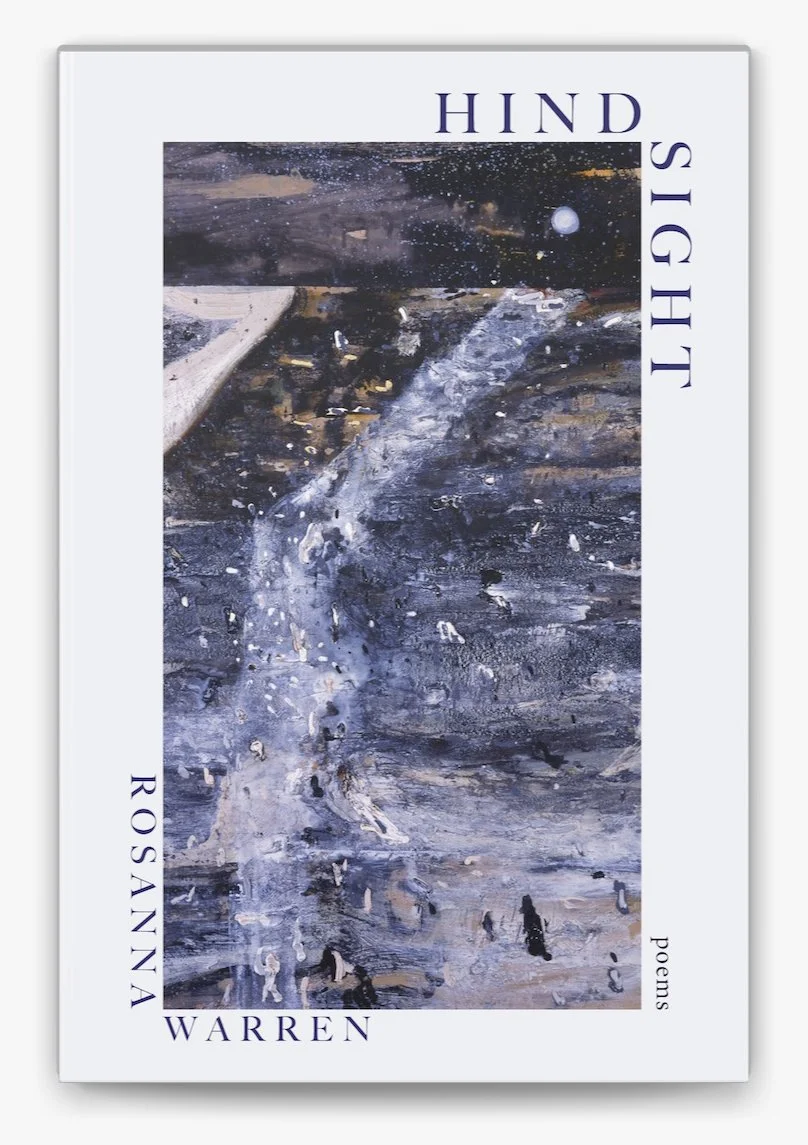
Critics often ignore the book cover as if to avoid the accusation of judging anything besides the text within. With Warren’s collection, it is difficult not to note the painting by John Walker from his celebrated “Seal Point” series, small Maine coast views painted with abstract gusto. The painting’s energy seems the perfect match for the poems within.
Rosanna Warren, Hindsight
W.W. Norton & Company, 2023 • ISBN 978-1-324-11695-0, $26.99
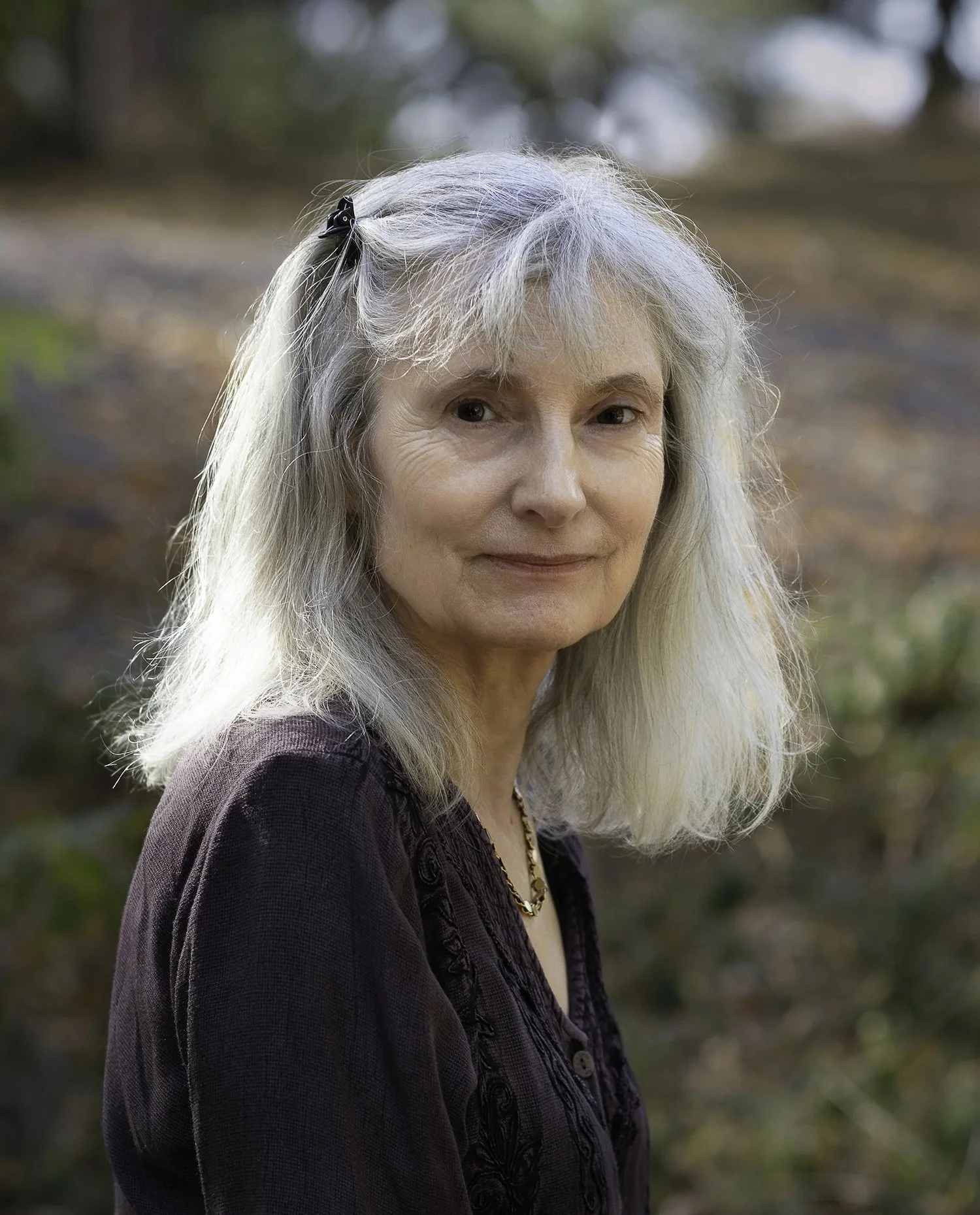
Rosanna Warren is an acclaimed poet, whose research interests include translation, literary biography, literature and the visual arts, and relations between classical and modern literature. Warren studied painting and comparative literature at Yale University, graduating in 1976. After several years of writing, painting, and odd jobs in Paris, Venice, and New York, she attended the Writing Seminars at Johns Hopkins University, receiving her M.A. degree in 1980. She taught for one year in the Department of English at Vanderbilt University and then joined the faculty of Boston University, where she taught in the University Professors Program, as well as the departments of English and Modern Foreign Languages, until her departure in 2011. She also taught for several years in several medium security prisons in Massachusetts and published pamphlets of poems by prisoners. Since 2012, she has been the Hanna Holborn Gray Distinguished Service Professor in the Committee on Social Thought at the University of Chicago.

Carl Little is the author of Ocean Drinker: New & Selected Poems, Deerbrook Editions, 2007), and Blanket of the Night: Poems, (Deerbrook Editions, 2024). His poems have appeared in The Café Review, Maine Arts Journal and Maine Sunday Telegram, among other publications, as well as in several anthologies, most recently, Timberline and Shoreline: A Range of Poems from Maine, which celebrates the Maine Poets Society’s 90th anniversary, and Echoes in the Fog: Literary Reflections on the Liminal Spaces of Maine’s Coast. In 2021, the Dorothea and Leo Rabkin Foundation awarded Little a Lifetime Achievement Award for his art writing.