A Lyrical Occasion | Tess Taylor
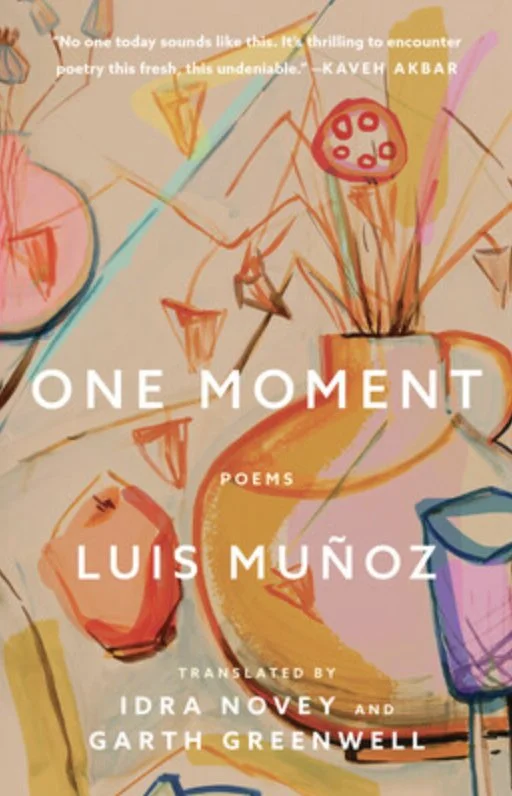
A review of Luis Muñoz’s One Moment
Translated by Garth Greenwell and Idra Novey
One of the functions of the lyric, to paraphrase Robert Pinsky, is to speak to the future, the past, worlds that have been and those that are to come. Which is to say, the lyric is allows us to build portals, slip through linguistic trapdoors, and cross dimensions. In the lyric mode, language twists and turns, leaning across boundaries to open new realms of possibility. As I often tell my students: A poem that asks “can you mail this letter” trades in the ordinary. A poem that asks “can you deliver this letter to my dead mother at the bottom of the sea…,” well, then, we are exploring a lyric occasion.
These days, one skilled poet who mines, surfaces, and trades in these shimmering occasions is the poet Luis Muñoz, now director of the Spanish-language creative writing program at the University of Iowa. His luminous One Moment is translated by Garth Greenwell (a novelist and his partner of many years) and Idra Novey.
Indeed, among the many charms of these deft lyrics are their wry premises. Some poems address mysterious people who also seem to be letters of the alphabet. Another poem is to a real yet also imaginary fountain. Still another poem conjures special glasses for seeing souls: One soul looks like “a tennis ball/ jammed between the metal bars/ of a gate,” and another resembles “a mirror/ where both images/ and likenesses were returned/ to their destinations/ without trying them on.”
Even seemingly ordinary moments can offer up their trapdoors, when discovered Muñoz: In Half Sleep of the Contractor Who Gives us Advice construction lingo comes back scrambled and oddly prophetic: “The floor is rolling. / Whatever you rashly set down / tips / into a drawer / with the rest of your efforts, / commotions.” And, in these tiny spaces, these opened drawers, words themselves are vectors, agents of change, who hang like “silver graffiti” in the air, or can fly through it, creating their own weather. In the poem The Transformations, “luminous things we said to earlier” launch “the interior of the afternoon into flight/ with spiraling darts/ that now find their mark.”
With some sequences aside, (and even within the sequences themselves) Muñoz tends to write brief poems. It is fun to be transformed in such small spaces. It is delightful to read a few lines and find that within moments (within one moment, even) they can upend the texture of one’s own imagination, one’s own day, can present some wild pink or storm gray or wavering blue sheen at the corner of thought. It is probably a sign that I liked these poems so much that I found myself reading them in the Spanish, thinking about alternate translations. This was less about critiquing what was there, but about wanting to get closer to the play in the poems, wanting to track where exactly the trap door sprung open on its nearly invisible latch.
Of course, these poems remind us, the latches really are everywhere. They also remind us that acts of imagination, whether of slippery mirrors or spiraling darts of well placed words, can offer sort of rest and delight, and can offer it quickly, despite the furious texture of our so called real world. In offering such capaciousness, these poems also argue for a greater field of capacity. There are several poems called ONE MOMENT in ONE MOMENT. My favorite begins, describing the moment: “I don’t think it’ll fit into my lemon-yellow tote of past events….” And indeed, isn’t this what we want from poetry, and from art? We want to sense the presence of something that doesn’t quite fit, and therefore expands, our sense of what’s possible. If this is the case, Muñoz offers us more than just a moment: He offers us a flexible, expansive gift indeed.
Luis Muñoz, Hindsight
Washington Square Press, 2026 • ISBN 978-1-668-22238-6, $17.00.
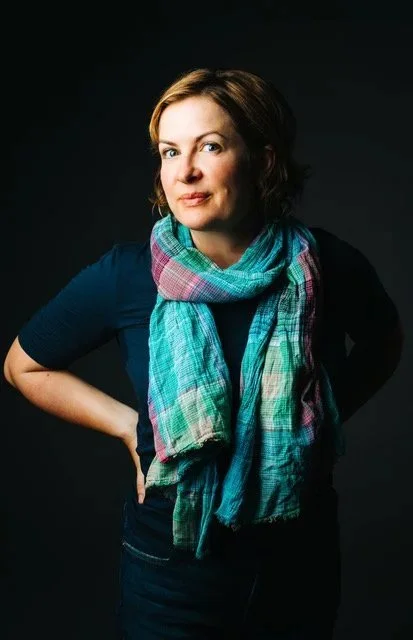
Tess Taylor is a poet, playwright and cultural critic who Ilya Kaminsky recently hailed as “the poet for our moment.” She writes about place, ecology and cultural reckoning, and her poems have received wide national and international acclaim. She is the author of five celebrated poetry collections including The Misremembered World, The Forage House, Last West: Roadsongs for Dorothea Lange, and Rift Zone (named a 2020 Boston Globe best book), and Work & Days (a 2016 NY Times best poetry book). Her work as a cultural critic appears in Harper’s Magazine, The Atlantic, CNN, The New York Times, and more. She has taught widely, from UC Berkeley to Queen’s University in Belfast, and served as on air poetry reviewer for NPR’s All Things Considered for over a decade. She recently published her first full length poetry anthology, Leaning Toward Light: Poems for Gardens and the Hands that Tend Them, a collection of contemporary gardening poems for an era of climate crisis. A staged adaptation of her book of poems about Dorothea Lange will launch at the Sonoma Valley Museum of Art in 2025. Her next book, Come Bite, will be published by Milkweed Editions in 2027. She lives and gardens just outside Berkeley, California.