The Empire of Being Alive | Bruce Spang
a review of The New Economy by Gabrielle Calvocoressi

When one reviews most books, one can assume the audience shares many of the author’s assumptions about reality. Calvocoressi’s book, however, defies common assumptions. To read it, I found ways into the book that let me hear what a non-binary person was saying. Once I did, the exuberance, charm, wit, and profundity came through like light flooding into a room after the shade is lifted. Let me, therefore, provide a preamble to my review about how I had to confront my own narrow-mindedness to absorb the full impact of this book.
When you are asked to speak about a non-binary author, you are invited to address them as “they.” Doing so requires you to step outside the common pronouns that identify someone as a “he” or a “she.” When you cannot categorize someone as either a “he” or a “she,” you are released from the stereotyped ways of seeing a person as a guy who likes sports or has an unnerving interest in machines or as a gal who has learned the art of applying makeup or believes in the importance of relationships. You have to acknowledge the author as a plurality of masculine and feminine traits. As such, you are being more honest about the spectrum of people, some of whom have an affinity for both manly and womanly qualities, who exist in our daily lives but who are, for the most part, ignored.
Since I am a gay man, I’ve always been mystified by how supposed “real men” act so macho, but once you get to know them, they reveal surprisingly feminine traits. Yet I must admit, I’m inclined as a guy who grew up in the 1950s to identify gender in a binary way. That kept getting in my way. I kept wondering as I read the poem, “Is she a person who wanted to be a he, or is he a person who wanted to be a she?” Calvocoressi’s gender fluidity mystified me, and I kept wanting to fit her/him into a category.
Once I gave up wanting to know that, I could relax and enjoy the book. To give an honest appraisal of C’s book, I had to let myself experience what it is like to inhabit a body that is transgressive to their identity. C’s poems explore the ambivalence of being in a body. Getting used to their talking about the body as a “skin sack,” “house vessel,” or “light body,” as if it were an object, was baffling to me. It was one of the first assumptions I had to confront.
For me, despite my realizing that, early on, my sexual attraction to other guys was not normal, and that my body seemed to have a mind of its own, feeling contrary to how a guy should feel, I felt it was my body. All I had to do was get used to and finally accept what I felt was okay. I assumed others felt as I did.
C’s bodily awareness was, and is, quite different. Their poems explore the angst of feeling alien from their body as well as coming to accept the two-sidedness of their being. C’s poems explore, as they say, the layers of reality. Some poems, written during the Lenten season, delve into religion. Some capture the trials of their medical issues and extended illness. C uses the cistern as a central trope. It’s an interesting way to bring together an array of subjects and topics into a single image.
I remember when I lived in Maine, our house had, hidden under the kitchen floor, a ten- foot-deep cistern that once provided the house with water. C’s cistern poems function as a reservoir to contain the many contraries of their life, gathering together poems about rage, love, envy, and regret. They can write about bees, premenopausal reactions, bleeding for days, the effect of light on her eyes, and bones on top of bones. As she says, “I tried/to listen for all the layers.” What is at stake for C is not just how they manage in a society that not only denies their right to exist but is often disgusted by them and finds them contrary to the way men or women should be. At issue for them is how one can get outside the one gender body, be other than what one was given, and, in addition, how one can get outside one’s being seen as sick. They do it with humor and irony, with wit and honesty. C asks “How does every person not cry out/all the time!” Their answer is never simple. They can say, “Yes, it was good to eat/doughnuts. Yes. I was blessed by many/days of joy.” But there is never a wavering for an easy answer, a quick resolve. They can linger in the darkness, “to want to take the food off other people’s/plates,” and “to fall on our knees from/the sorrow of what we’d done.” But not for long.
C’s book is redeeming since they remain open to what life has, is, and will bring. Their humor wins out. They aren’t bent on making it right or finding some truth with a capital T. In fact, in many poems, they leave blank space because they don’t know what the right word would be. Like John Keats’s notion of “the excellence of Art is its intensity, capable of making disagreement evaporate,” C lets us step outside the ego. C, I think, would concur with Keats that by the power of the imagination, a poet can gain the capability “of being in uncertainties, Mysteries, doubts without any irritable reaching after act and reason.” Keats wrote that after attending a literary gathering where other poets discounted one another, showing off their intellectual rigor. He was outraged by their petty quibbling. He wanted poetry that rose above such egotistical displays.
C’s poems have achieved such a stature. By the end of the book, we feel their spirit rising, how they can miss “the pizza/ place, tang of garlic and tomato/in the back of my throat/just from the smell of it. I miss you. I wish you/were here.” With forty-one days of Lent having passed, they reflect on their past life that encapsulates the remarkable range of their acceptance of being who they are
I keep thinking of
wiping sweat from
his brow or telling
him
I don’t even
know what. When I
was 33 I spent a lot
of time with my
head in my hands.
Walking around Los
Angeles feeling
blessed by the sun
and jacarandas and
endless swimming
pools. Also lonely
beyond measure.
And also like I was
meant to
don’t even know
what.
I love how they can leave out words, admit that sometimes, somethings can’t be articulated, and equally sometimes, we don’t know what it means. How many poets do you know who have the humility and presence to say that? I’m afraid I don’t know any. But C does. This book will release constraints that you may have about what can be said. I know it has for me. C knows how to hold out their hand and carry us into the empire of being.
Gabrielle Calvocoressi, The New Economy
Copper Canyon Press, 2025 ISBN 978-1-55659-721-3 $22.00
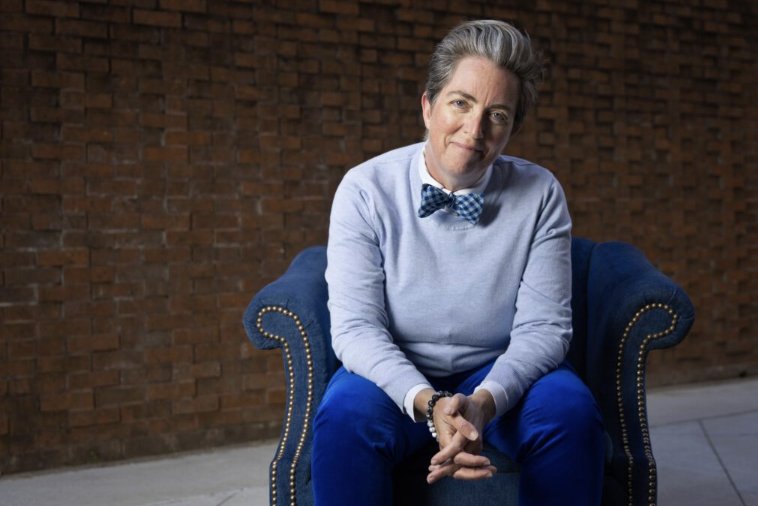
photo © Alyssa LaFaro
Gabrielle Calvocoressi is the author of The Last Time I Saw Amelia Earhart, Apocalyptic Swing (a finalist for the LA Times Book Prize), and Rocket Fantastic, winner of the Audre Lorde Award for Lesbian Poetry. Calvocoressi is the recipient of numerous awards and fellowships including a Stegner Fellowship and Jones Lectureship from Stanford University. Calvocoressi’s poems have been published or are forthcoming in numerous magazines and journals including The Baffler, The New York Times, and POETRY. Calvocoressi is an Editor at Large at Los Angeles Review of Books, and Poetry Editor at Southern Cultures. Works in progress include a non-fiction book entitled, The Year I Didn’t Kill Myself and a novel, The Alderman of the Graveyard. Calvocoressi teaches at UNC Chapel Hill and lives in Old East Durham, NC, where joy, compassion, and social justice are at the center of their personal and poetic practice.
Bruce Spang, former Poet Laureate of Portland, is the author of two novels, The River Crossed (2024) and The Deception of the Thrush. He has published five books of poems, including Twist (2025), All You’ll Derive: A Caregiver’s Journey. He has a new book of letters, Dear Teen, Dear Poet: Coming of Age in Letters (2026), and a memoir, No Way Back: A Young Man’s Search for Home (2026). He teaches at the Great Smokies Writing Program. He lives in Candler, NC, with his husband, Myles Rightmire, and their two dogs.