Examinations of Ongoingness | Jefferson Navicky
a review of Old Stranger by Joan Larkin
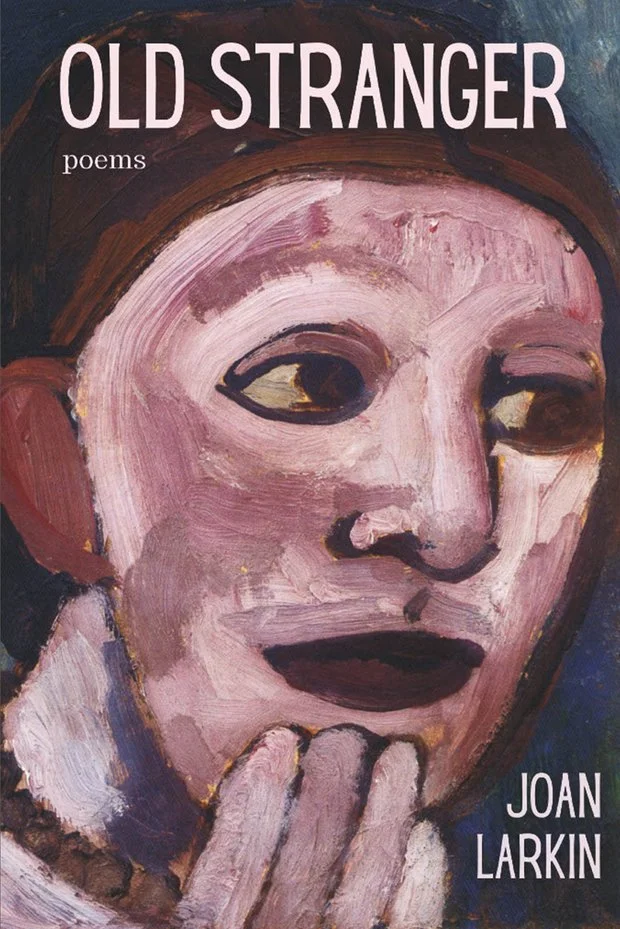
On the radio the other day, I heard a preacher talking about vision. How there are some things like stars in the night sky that we can see better by not directly looking at them. The preacher was talking about the fires of hell. Either that or the blinding glory of heaven. I didn’t stay on the radio station long enough to figure out which one, but I didn’t have to. I knew what he was talking about—gestures of such look-away ocular shift can result in some of life’s most transcendent moments. In fact, it’s one of the foundational principles of poetry. Joan Larkin knows this, and I thought about it often while reading her sixteenth book, Old Stranger (Alice James Books 2024).
“I want to be that radiant / shape—bird only if you / step back to see me better.” This is from her poem “Fresco” and she’s talking about a dove in the eponymous fresco. To me, this is the kind of shifting perspective that makes poetry the thing of beauty I look for. It’s both the radiant shape, its amorphous mystery, as well as the resolution into bird that makes for beauty. And, it’s the process of shifting between the two…from painted shape…into dove.
And also the desire to BE that radiance, which is the poet’s realm. Something a poet is particularly well-suited to claim.
In Larkin’s poem, “Cancun,” the shifting moves to the sky:
In the sky a devil kissing a witch
or goat an elephant, or elephant-
god whose trunk is a sea horse, or
scorpion curled in the jaws of a rat
wind-filled now, dolphin smiling
at Mozart’s wig drifting east,
space filled with Midas’ torn
cotton.
Here, rather than one image clarifying into another, we’re watching a series of images morph into each other and pinwheel across the sky as clouds brought to life through the poet’s imagination.
It’s heady stuff, but Larkin also fully inhabits the carnal world. In the notable title poem, a carbon steel kitchen knife comes “alive” to change “tomatoes to glistening / discs,” an instrument to “[rake] joy onto my plate.” It’s only in the startling last lines, which I won’t give away here, that the reader senses the inherent danger.
Bodies and their fleshy desires thread throughout the collection. The opening poem’s first line examines “my shameful flesh,” and three poems later, we get “the body / inside my body sways, a door / swollen in a wet month.” Bodies are sealed records, home for breathtaking fists of pain, dark articulate slits. As Eileen Myles says in their blurb for the book, “I mean, wow, this is why one is a poet all their life. To make this.” Indeed.
As much as I enjoyed the collection’s visceral moments, it was Larkin’s surprising attention to—of all things—punctuation that most held my affection. Through Larkin’s interpretation, the humble hyphen and ampersand become symbols of revolution and ongoingness. In “Hyphen,” the eponymous punctuation mark is “quick-witted,” adds dignity to new sons-in-law. Most importantly, this little coupler “vexes tramplers-in-charge.” And thus, through the hyphen’s grammatically revolutionary nature, the not-so-stuffy poem lifts off the page in elegant un-coupled couplets.
The final word goes to the casually rebellious ampersand. Artfully described as “a needle threading itself” or “a pregnant roundness,” the ampersand’s shape clearly draws the poet, who senses the tensile possibilities in the ways an ampersand connects its clauses. Like a spring or a bolt of lightning from a cloud, energy gathers and releases, and so does inspiration— “My twisted tongue lets go / & I rise like smoke.” – and not only inspiration for this magnificent poem, but inspiration to simply keep going. Or as the eighty-six year old poet says in “White Pine,” “Death poem, wait. // Joan, keep walking.”
Reader of Any Age: I dare you to not find inspiration in this fine collection.
Joan Larkin, Old Stranger
Alice James Books, 2024 • ISBN 9781949944648 • $24.95

Joan Larkin is the author of five previous collections of poetry, including Blue Hanuman (2014); My Body: New and Selected Poems (2007), which received the Audre Lorde Award from the Publishing Triangle; Lambda Literary Award winner Cold River (1997); and Housework (1975). With Jaime Manrique, Larkin translated Sor Juana’s Love Poems, a bilingual edition of Sor Juana Inés de la Cruz’s poetry (1997). Her prose works include If You Want What We Have: Sponsorship Meditations (1998) and Glad Day: Daily Meditations for Gay, Lesbian, Bisexual, and Transgender People (1998). Her plays include The AIDS Passion, The Living, and Wiretap.

Jefferson Navicky is the author of four books, most recently, Head of Island Beautification for the Rural Outlands, a Finalist for the Big Other Book Award in Fiction, as well as Antique Densities: Modern Parables & Other Experiments in Short Prose, winner of the Maine Literary Award for Poetry. He lives in midcoast Maine.