Delivering an Inheritance–or You Are Who I Love | Melissa McKinstry
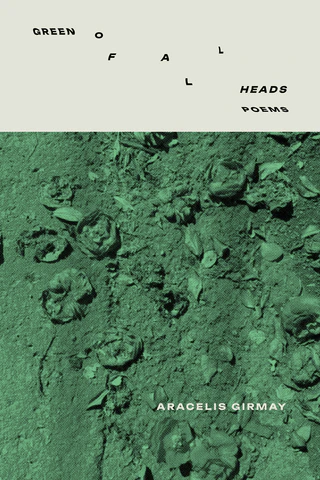
a review of Aracelis Girmay’s Green of All Heads
NOTES
22 April 2026:Green of All Heads by Aracelis Girmay was short listed for the 2026 Griffin Poetry Prize! Congratulations to Arcelis Girmay and BOA Editions! Winner to be announced in June!
2 April 2026: Aracelis Girmay, Knight Family Professor of Creative Writing and Professor of English, received the 2026 PEN/Voelcker Award for Poetry Collection for Green of All Heads (BOA Editions). PEN America awards the prize to “a poet whose distinguished collection of poetry represents a notable and accomplished literary presence.”
In How to Read a Poem and Fall in Love with Poetry, Edward Hirsch says, “[The elegy] ritualizes grief into language and thereby makes it more bearable. The great elegy touches the unfathomable and originates in the unspeakable, in unacceptable loss...It turns loss into remembrance and delivers an inheritance. It opens a space for retrospection and drives a wordless anguish, wordless torment, toward the consolations of verbal articulation, verbal ceremony.”
Green of All Heads is an embodied response to the sudden and tragic death of Girmay’s father, Girmay Keleta, who, along with his best friend, was hit and killed by a car while crossing a street. It is a collection of remembrance and inheritance. These poems are physical. They hold teeth, heads, hands, eyes, and ears. “Bones were tunnels. // I could not follow where they led,” the speaker mourns.
Girmay is a skilled lyric poet, weaving detail and imagery without reliance on narration or explanation. This is a collage-like collection that invites us to experience grief rather than read reportage about grief.
Girmay is adept at inviting form to reflect the shifting mind of the grieving speaker. She uses the prose poem to hold a stream of consciousness flow evoked by laughing gas in “I Go to the Dentist.” Despite the speaker’s fear, she assures us “the laughing gas made me brave.” We come to understand this as courage for the root canal and courage for the loss of her father:
“ …what comforts me is to think of your teeth and how for weeks after you died I could not feel myself because parts of you had settled in my branches and I grew the new gray hair right in front and knew that you were sleeping there wrapped in your ghabi and my teeth, my chewing, when I ate, were not mine but yours so much that it made me weep to eat. I like to remember right now how sharp, how full of smiling. How clean and full of integrity your chewing and eating.”
Five years prior to his death, Girmay’s father suffered a stroke. In a poem titled, “Right after Dad’s Stroke,” the speaker experiences the dreamy disorientation of shock, wandering through pronouns and identities as she reels:
It had felt impossible,
I mean, to continue
My story, how
For “him” I said
“They,” or said
My brother’s name.
& then my son’s,
& also sometimes
Instead of “Dad”
I said “I.”
This collection flows through time to remember and honor her father as parent, activist, and legacy to herself and her own children. Certain nouns recur in the collection, little groundings for the speaker: horse, flower, fish, and green– “green of your joy…green of our tears.” As the mother of two young children, Girmay considers the lineage–the “green of all heads” that extends before and beyond her father: the legacy of his life, his work, his bones–his Eritrean heritage and his activism as an immigrant in the diaspora. “He is not ours alone,” the speaker realizes:
“I think there was something
Very powerful, very much
About the truth of his dearness to us
& how already his energies
Were distributing across us
& what I thought was confusion was not.”
The penultimate section of the collection includes just one poem that stretches over four pages. “You Are Who I Love” (1/2017–1/2025) employs anaphora to corral a generous, outward- facing, and timely litany of love–from nurses to bakers to protestors to mourners to cactus to crow. The list poem ends with a fierce conclusion: “witnesses to each other’s tenderness, which, this moment, is fury, is / rage, which, this moment, is another way of saying You are who I love / You are who I love you You and you and you are who”.
Awash in grief, the speaker of the opening proem had vowed, “Not to fill my ears with the sound of my own motion / but with ear”. By the opening poem of the final section, however, after the cathartic section of “You Are Who I Love,” the speaker announces,
i am learning to lift -- my voice -- like a flower -- in --
a field of flowers -- sometimes, I hear you -- all heads
left open at the top -- through mine is wonder -- now
Green of All Heads is a collection of lyric poetry that inhabits the liminal space of grief, its ceremony, and a return to song. This is a collection for anyone who knows this space. As Kevin Young says in The Art of Losing: Poems of Grief and Healing, “Poetry steps in at those moments when ordinary words fail: poetry as ceremony, as closure to what cannot be closed.”
Prompt:
Write a poem relying on an embodied experience rather than direct narration. See, for example, the poems quoted above, and “Never Could I Be Without You / I Thought We Had More Time,” on pages 75-77 of Green of All Heads. How and where does the body hold grief, shock, or confusion? What is the felt experience? See if you might let go of the urge to tell the story, and instead, let your reader discover an embodied ceremony of feeling. Let the detail and from hold the emotion without explaining it.
Aracelis Girmay, Green of All Heads
BOA Editions, 2025 • ISBN 978-1-960145-71-0 • $19.00

Aracelis Girmay is the author of four books of poems: Green of All Heads (BOA Editions, 2025); the black maria (BOA Editions, 2016); Teeth (Curbstone Press, 2007), winner of the GLCA New Writers Award; and Kingdom Animalia (BOA Editions, 2011), winner of the 2011 Isabella Gardner Poetry Award and a finalist for the National Book Critics Circle Award and the Hurston/Wright Legacy Award. She is also the author/illustrator of the collage-based picture book changing, changing.
For her work, Girmay was nominated for a Neustadt International Prize for Literature in 2018. For the last several years, Girmay was on the faculty of Hampshire College's School for Interdisciplinary Arts and before that taught community writing workshops with young people in New York and California. She has received grants, training, and fellowships in support of her work from the NEA, the Whiting Foundation, Civitella Ranieri, the Cave Canem Foundation, and the Community~Word Project, among other programs. From 2021-2025, Girmay served as the editor of BOA Editions’ Blessing the Boats Selections and is on the editorial board of the African Poetry Book Fund.
She is the editor of How to Carry Water: Selected Poems of Lucille Clifton (BOA, 2020) and So We Can Know: Writers of Color on Pregnancy, Loss, Abortion, and Birth (Haymarket Books).
Melissa McKinstry hosts poetry and jazz events and curates a Poet Tree in San Diego. Her poetry appears in many journals including Beloit, Adroit, and Best New Poets, and was selected for the 2025 New Ohio Review Literary Prize and a 2026 Pushcart Prize. The inaugural writer-in-residence at the Millay House Rockland, she currently serves on their Board and on the Alumni Council for Pacific University’s MFA program.